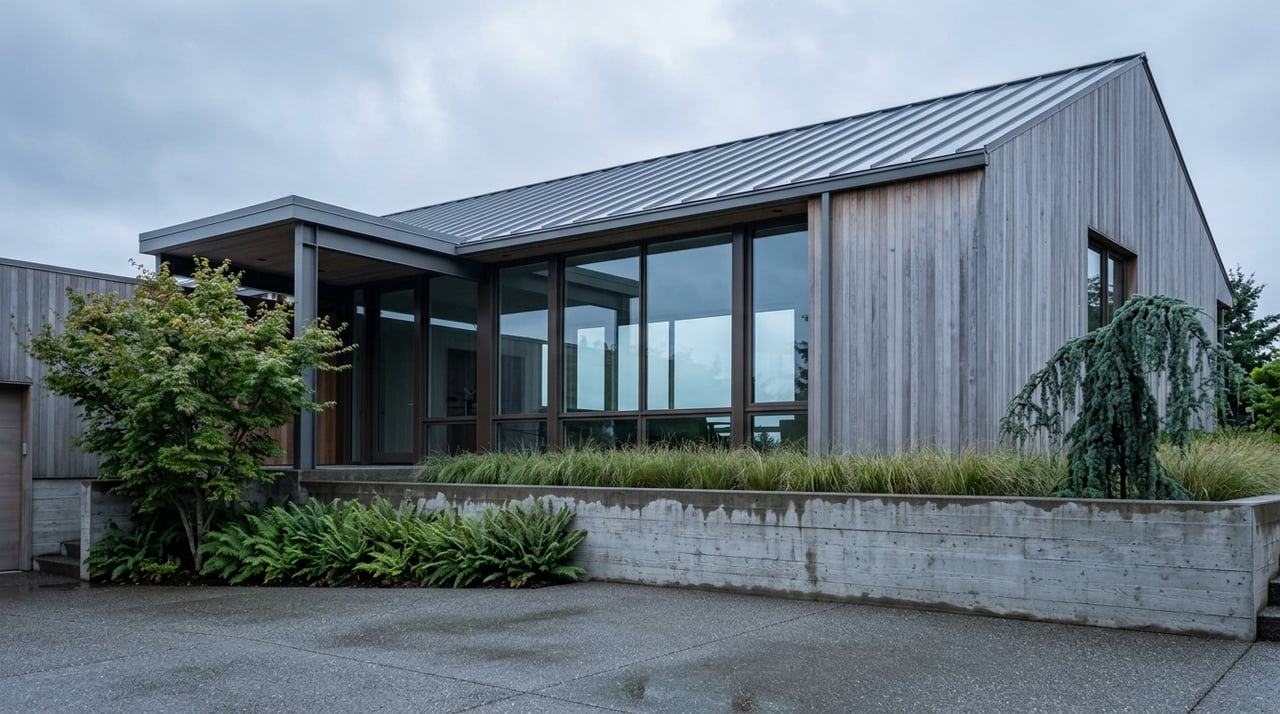
How Bluff Regulations Can Affect Edmonds Waterfront Sale Timelines
September 24, 2026
September 24, 2026
Walk through downtown Edmonds this fall and you'll hear the same story from most agents: homes are moving fast, buyers are competing, and well-priced listings barely last a weekend. Public MLS-sourced numbers this year back that up. Typical Edmonds homes have been going under contract in about a week, and multiple offers are common on anything priced right in the Bowl or along the Highway 99 corridor.
Drive up to Sunset Avenue, or out along the Woodway shoreline, and the story changes completely. Waterfront and bluff-top listings in that price band have been sitting for two to three months this year, sometimes longer. Most sellers in that position assume it's the price scaring buyers off, or that the pool of people who can write a check for a $2 million view home is just small. Both are true to a point. But there's another factor to consider: the City of Edmonds runs a completely different permit and inspection calendar for anything built on or near a bluff, and that calendar has a hard deadline coming up in a week.
Edmonds' development code defines a bluff as any slope at least 10 feet high that rises steeper than a 45-degree angle. That single definition draws a legal line through a meaningful chunk of the city's most desirable real estate. The area above Sunset Avenue, the bluff edge near Brackett's Landing, stretches of Perrinville, and most of the Woodway shoreline corridor sit inside what the city formally calls the North Edmonds earth subsidence and landslide hazard area.
A local arborist crew that works these lots for a living, K&J Tree Works, describes Edmonds as four distinct terrains packed into a couple of miles: the hilltop neighborhoods sitting around 300 feet up, the dense Bowl valley in the middle, the bluff edge itself, and the narrow waterfront strip below. The soil under most of that bluff edge is shallow, Edmonds-series soil sitting over marine clay that doesn't drain well and slumps when it gets saturated. Layer in Douglas fir stands that mostly regrew between 1925 and 1955 after the original logging, now reaching the end of a stable root life on ground that was never deep enough to anchor them properly, and you have a landscape that behaves differently than the flatter lots three miles inland.
None of that is news to anyone who has lived on the bluff for a while. What most sellers don't realize is that the city has turned that geology into a specific set of permit and inspection rules, and those rules run on a fixed seasonal clock.
Under the city's development code, any earthwork, grading, or geotechnical monitoring on a property inside the hazard area is treated differently depending on the time of year. From October 1 through April 30, the code restricts new site access for that kind of work unless the property owner's geotechnical engineer submits written concurrence, and the city can require a peer review of that request before approving it. During that same window, weekly erosion and sedimentation control inspections are required on active sites, and any deviation from an approved geotechnical report has to be flagged to the city separately.
Translate that into plain terms for a seller: if a pre-listing walkthrough turns up a drainage problem, a slumping retaining wall, or anything that makes an inspector want a fresh geotechnical opinion, the easiest and fastest path to resolving it closes on October 1. After that date, the same fix is still possible, but it runs through an extra layer of engineer sign-off and city review that simply doesn't exist between May and September.
Here's what that looks like side by side.
| Typical Bowl or inland listing | Bluff-top or waterfront listing in the hazard area | |
|---|---|---|
| Earthwork timing | No seasonal restriction | Restricted Oct 1–Apr 30 without engineer concurrence |
| Site inspections | Standard building inspection only | Weekly erosion-control inspections required in season |
| New hard armoring | Not applicable | Must clear a three-year damage standard |
| Disclosure at closing | Standard seller disclosure | Recorded covenant binds future owners, heirs, and assigns |
That last row matters as much as the first.
Buyers looking at a bluff-top or waterfront home sometimes assume that if the slope looks unstable, they can just fix it after closing by building a bulkhead. The code sets a much higher bar than that. Edmonds only allows new or enlarged shoreline stabilization structures when a geotechnical report shows the primary structure is likely to be damaged by tidal action, currents, or wave activity within three years. Ordinary sloughing or slow erosion of a steep bluff, on its own, doesn't meet that standard. Where a bulkhead is permitted, it also has to sit close to the eroding bank, generally within six feet of the toe, and tie in flush with any bulkheads on neighboring properties.
That three-year test exists because hard armoring changes the beach for everyone downstream of it, not just the property that installs it. It's also exactly the kind of detail a buyer's inspector or lender will ask about on a waterfront file, and it's worth having an answer ready before the question comes up mid-escrow rather than after.
The city's geotechnical rules don't stop at the building permit. Any property found to sit within the hazard area has to have its geotechnical findings, and the mitigation measures tied to them, fully disclosed to the applicant and recorded in a covenant that binds future owners, heirs, and assigns. In practice, that means the disclosure doesn't expire when the current owner sells. It travels with the parcel.
This isn't a hidden defect. It's a documented, recorded piece of the property's history, and a well-prepared seller treats it that way, pulling the existing geotechnical file together before a buyer's agent has to go looking for it during due diligence.
Edmonds' bluff rules didn't appear out of nowhere. A retrospective published on My Edmonds News revisits a major 1997 landslide on the bluff at what was then Rosary Heights, a property along Woodway Park Road once owned by an order of Dominican nuns. Commenters on that piece still talk about seeing the debris from the ferry days later.
More recently, in November 2019, a slide roughly 50 feet by 100 feet came down near 73rd Place West and North Meadowdale Road, striking a home's gas meter and forcing the evacuation of about 30 homes while crews confirmed the leak was secured, according to KIRO 7's coverage at the time. Nobody was hurt in either event. But both are the reason a geotechnical engineer, not just a home inspector, ends up involved in most bluff and waterfront transactions here.
If you own a waterfront or bluff-top property in Edmonds and you're weighing a fall listing, a few things are worth doing now rather than after an offer comes in.
Does every waterfront home in Edmonds fall inside the landslide hazard area? No. The hazard area is defined by the city based on slope and geology, primarily along the North Edmonds bluff and portions of the Woodway shoreline corridor. Some waterfront and view parcels sit outside the formal boundary. A pre-listing conversation with the city's building division or a geotechnical engineer will confirm where a specific parcel falls.
What if my home already has a bulkhead? The three-year damage standard applies to new bulkheads.
How long does a geotechnical report typically take? Timing varies by engineer and by how much drainage or slope history needs to be reviewed, but ordering one before the October 1 seasonal restriction gives the most flexibility if any follow-up site work turns out to be needed.
Selling a waterfront or bluff-top home in Edmonds rewards the same thing it always has: knowing the ground you're standing on, literally and procedurally, before a buyer's team starts asking questions about it. If you're weighing a fall listing on the bluff, in Woodway, or anywhere along the Edmonds shoreline, Ryan Hoff can walk through your specific parcel, what the code requires, and what your home is worth in today's market. Request a free home valuation to start that conversation.
This article is general information, not legal, tax or financial advice. Consult a qualified professional about your situation.
Stay up to date on the latest real estate trends.
My goal is not just to complete a sale, but to make sure my clients are well-educated throughout the process. My clients' needs come first and always making sure that they are satisfied. Providing my knowledge of market conditions and real home prices equips a seller or buyer to make their own decisions without a second thought.